

For decades, e-commerce has been designed around a simple assumption: humans make purchasing decisions.
That assumption is beginning to change.
AI shopping agents are emerging as a new participant in commerce, one that can research products, compare alternatives, evaluate trade-offs, and increasingly influence what customers buy.
This is more than another retail technology trend. It represents a shift in how purchase decisions are made. As agentic AI shopping evolves, brands may find themselves competing not only for customer attention but also for the recommendation of intelligent agents acting on a customer’s behalf.
The retailers that understand this shift early will be better positioned to adapt to a future where AI is no longer just supporting commerce—it is actively participating in
What Are AI Shopping Agents?
AI shopping agents are intelligent systems that acts as virtual shopping assistants and help consumers evaluate products, compare options, and make purchasing decisions through conversation.
What makes them significant isn’t their ability to answer questions—it’s their ability to reduce the effort required to make a decision.
For years, ecommerce has relied on customers to do the heavy lifting: searching products, comparing features, reading reviews, and narrowing down choices. Ecommerce AI agents shift much of that work to AI. Instead of presenting endless options, they help shoppers move from intent to decision faster.
This shift is driving the rise of agentic AI shopping, where AI systems move beyond information retrieval and actively assist customers in achieving a specific outcome.
AI Shopping Agents vs Traditional Ecommerce Chatbots
The distinction between chatbots and AI shopping agents lies in their objective. Chatbots are designed to answer questions. Shopping AI Agent is designed to help customers reach a decision.
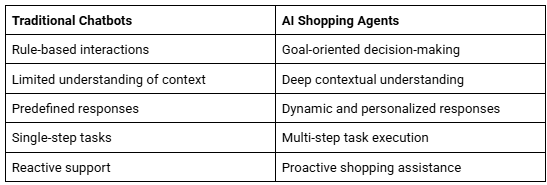
As Shopping AI Agent is becoming more capable, retailers will need to optimize not just for product visibility, but for how effectively their products are recommended, compared, and evaluated by intelligent systems acting on behalf of consumers.
For more detailed information, read: Agentic AI vs Traditional Automation: Why Modern Enterprises Can’t Treat Them the Same
The Rise of AI Shopping Agents
Agentic AI shopping platforms are gaining momentum as both consumers and retailers become more comfortable with AI-driven decision-making. According to Salesforce’s 2025 Connected Shoppers Report, 75% of retailers believe AI agents will be essential to staying competitive, while 39% of shoppers already use AI for product discovery, rising to 54% among Gen Z consumers.
But the rise of Agentic shopping AI system isn’t simply another wave of ecommerce automation. For the first time, AI is moving closer to the purchase decision itself.
Search engines helped customers find products. Recommendation engines suggested products. Chatbots answered questions. An agentic shopping AI system combine all three capabilities while helping shoppers evaluate options and move toward a decision.
This shift matters because online shopping has become a choice overload problem. As product catalogs expand, consumers spend more time researching and comparing than buying. AI shopping agents reduce that burden by narrowing options, surfacing relevant products, and providing decision support in real time.
The result is a new model of commerce where retailers are no longer competing solely for customer attention, but are increasingly competing for recommendations within AI-driven shopping experiences.
How AI Shopping Agents Work
At a glance, an AI shopping agent may look similar to a chatbot. Both interact through conversation, answer questions, and help customers find products. The difference lies in what happens behind the scenes.
A traditional chatbot responds to individual queries. An AI shopping agent works toward a goal.
For example, if a customer says, “I’m looking for a running shoe under $100 for daily training,” the agent doesn’t simply search for matching products. It interprets the intent, identifies key requirements, evaluates available options, and continues refining recommendations based on follow-up questions.
To do this, virtual shopping agents typically combine several capabilities:
Understanding Customer Intent
Rather than relying solely on keywords, AI shopping agents can analyze the context behind a request. By considering factors such as the user’s language, browsing behavior, past interactions, and expressed preferences, they may infer whether someone is casually exploring options or actively intending to buy, enabling more relevant recommendations.
Accessing Real-Time Product Information
An AI shopping agent connect with product catalogs, inventory systems, pricing databases, and customer records. This allows it to recommend products that are actually available, rather than relying on static information. It
Reasoning Across Multiple Factors
One of the defining characteristics of agentic AI shopping is the ability to evaluate trade-offs. An agent can compare products based on budget, features, ratings, availability, brand preferences, and previous customer interactions before presenting recommendations.
Taking Action Across the Shopping Journey
Beyond product discovery, a shopping AI agent can perform tasks such as:
- Tracking orders
- Answering delivery-related questions
- Initiating return requests
- Updating customer information
- Escalating complex cases to support teams
This ability to combine understanding, reasoning, and action is what separates virtual shopping agents from traditional ecommerce automation tools.
As retailers continue to connect AI agents with more business systems, these assistants are evolving from recommendation engines into intelligent commerce agents capable of supporting customers throughout the entire buying journey.
AI Shopping Agents Impact on Retail
The impact of AI shopping agents extends beyond customer support and product recommendations. They are changing how retailers manage product discovery, customer engagement, and post-purchase experiences at scale.
According to Capgemini, nearly 71% of consumers want generative AI integrated into their shopping experiences, highlighting growing demand for more intelligent and personalized interactions.
Improving Product Discovery
One of the biggest challenges in ecommerce is helping customers find the right product quickly. Traditional filters and search bars require shoppers to know exactly what they’re looking for.
AI shopping agents make product discovery conversational. Customers can describe needs in natural language, ask follow-up questions, and AI Agent for personalized recommendations suggests products tailored to their preferences, budget, and purchase intent.
This reduces search friction and helps shoppers move from browsing to buying faster.
Increasing Conversion Opportunities
Many online purchases are lost not because customers dislike a product, but because they remain uncertain.
AI shopping assistant help reduce that uncertainty by answering questions in real time, comparing alternatives, explaining product features, and guiding customers toward informed decisions.
Instead of leaving customers to conduct their own research, retailers can provide personalized assistance throughout the decision-making process.
Scaling Personalization Beyond Recommendations
Most personalization today is based on previous purchases or browsing behavior. AI shopping assistant add another layer by understanding intent within a conversation.
A returning customer and a first-time visitor may receive entirely different guidance based on their goals, questions, and preferences, creating a more individualized shopping experience.
Transforming Post-Purchase Support
The customer journey doesn’t end after checkout.
AI shopping agents can handle order tracking, delivery updates, return requests, warranty information, and common support inquiries without requiring customers to navigate multiple channels.
For retailers, this reduces support workloads while providing customers with faster resolutions.
Turning Customer Conversations into Business Intelligence
Perhaps the most overlooked benefit of agentic AI shopping is the data they generate.
Every interaction reveals customer preferences, objections, product concerns, and purchase intent. When analyzed effectively, these insights can help retailers identify emerging trends, optimize product assortments, refine marketing campaigns, and improve customer experiences.
In this way, AI shopping agents become more than customer-facing tools—they become a source of continuous market intelligence that helps retailers make smarter business decisions.
How Do AI Shopping Agents Handle Refunds and Disputes?
Refunds and disputes are among the most complex interactions in retail. Unlike product recommendations, they often involve policies, transaction histories, customer sentiment, and potential fraud risks.
AI shopping agents are increasingly being used to streamline these processes, but they don’t operate independently. Instead, they work within rules, policies, and approval workflows defined by the retailer.
Automating Refund Requests
When a customer requests a refund, an AI shopping agent can instantly verify order details, check return eligibility, review refund policies, and guide the customer through the next steps.
This reduces the time customers spend searching for information while helping support teams handle higher volumes of requests more efficiently.
Managing Routine Disputes
Not every dispute requires human intervention.
For issues such as delayed deliveries, incorrect tracking updates, damaged shipments, or missing order information, AI shopping agents can access relevant data, provide status updates, and recommend resolutions based on company policies.
This enables faster responses and more consistent customer experiences.
Knowing When to Escalate
One common misconception about agentic AI shopping is that it can fully replace human support teams.
In reality, the most effective AI shopping agents know when not to act.
Complex disputes involving chargebacks, fraud investigations, policy exceptions, or high-value purchases often require human judgment. In these cases, the agent can gather relevant information, summarize the issue, and route it to the appropriate support representative.
Balancing Automation and Trust
The goal isn’t to automate every refund or dispute. It’s to reduce friction for straightforward cases while ensuring customers receive appropriate support for more complex situations.
With the adoption of ecommerce AI agents for customer support, retailers can streamline customer service operations, handle common issues more efficiently, and provide a smoother post-purchase journey without compromising customer confidence.
Shopify AI Shopping Agents
As AI shopping agents gain traction, Shopify merchants are exploring how these systems can enhance customer experiences across the entire buying journey.
The opportunity is significant. Shopify powers millions of businesses worldwide, giving merchants access to rich customer, product, inventory, and order data—the foundation AI shopping agents need to operate effectively.
What Can Shopify AI Shopping Agents Do?
When connected to a Shopify store, an AI shopping agent can access relevant business data and assist customers in real time. Common use cases include:
- Personalized product recommendations
- Product comparison and buying guidance
- Inventory and availability checks
- Cross-sell and Upsell
- Order tracking and delivery updates
- Returns and refund assistance
- Customer support automation
Rather than moving between search bars, product pages, and support channels, customers can interact with a single intelligent assistant throughout their shopping journey.
Moving Beyond Traditional Ecommerce Experiences
Most ecommerce experiences are still built around navigation. Customers browse categories, apply filters, and manually compare products before making a decision.
AI shopping agents introduce a more conversational model.
Instead of searching for products, customers describe what they want. The agent interprets their intent, evaluates available options, and provides tailored recommendations based on product data, customer preferences, and store policies.
For merchants, this creates a more personalized and efficient buying experience without requiring additional effort from customers.
The Importance of Data Quality
The effectiveness of a Shopify AI shopping agent depends heavily on the quality of the underlying data.
Incomplete product descriptions, inaccurate inventory records, inconsistent attributes, or outdated policies can limit an agent’s ability to provide accurate recommendations and support.
Retailers looking to deploy AI shopping agents should focus not only on the AI itself but also on maintaining clean, structured, and up-to-date commerce data.
From Storefront Assistant to Revenue Driver
The long-term value of AI shopping agents lies in their ability to connect customer conversations with business outcomes.
Every interaction provides insight into customer intent, product preferences, common objections, and purchasing behavior. These signals can help merchants improve merchandising strategies, optimize inventory planning, refine marketing campaigns, and create more personalized customer experiences.
As Shopify merchants continue to adopt AI-powered commerce tools, AI shopping agents are likely to evolve from support assistants into intelligent commerce layers that influence discovery, conversion, retention, and growth.
Challenges of Implementing AI Shopping Agents
While AI shopping agents offer significant opportunities, successful implementation requires more than connecting a language model to an ecommerce store.
The effectiveness of an AI shopping agent depends on the quality of data, business processes, and governance frameworks that support it.
Data Quality Remains the Biggest Challenge
AI shopping agents can only work with the information available to them.
If product descriptions are incomplete, inventory records are inaccurate, or return policies are inconsistently documented, the agent’s recommendations and responses may be unreliable.
For many retailers, preparing product and customer data for AI is often a bigger challenge than deploying the technology itself.
Accuracy and Trust
Customers are increasingly comfortable interacting with AI, but they still expect accurate information.
An AI shopping agent that recommends unavailable products, misunderstands policies, or provides incorrect guidance can quickly erode trust and negatively impact customer experiences.
Retailers must ensure that AI agents are connected to real-time business data and operate within clearly defined boundaries.
Finding the Right Balance Between Automation and Human Support
Not every customer interaction should be automated.
While AI shopping agents can effectively handle routine inquiries, complex situations often require human judgment, empathy, and decision-making. The most successful implementations combine AI efficiency with seamless human escalation when needed.
Privacy and Governance Considerations
AI shopping agents often interact with customer profiles, purchase histories, payment information, and support records.
Retailers must ensure appropriate safeguards are in place to protect customer data, comply with privacy regulations, and maintain transparency around how AI is being used.
Measuring Business Impact
Many organizations focus on deployment without clearly defining success metrics
The real value of agentic AI shopping should be measured through outcomes such as improved conversion rates, reduced support volumes, faster resolution times, higher customer satisfaction, and increased customer lifetime value.
Retailers that approach AI shopping agents as a business transformation initiative rather than a standalone technology project are more likely to achieve sustainable results.
The Future of Agentic AI Shopping
The current generation of AI shopping agents assists in decisions. The next generation will begin making them.
The trajectory – based on where the underlying models and ecommerce infrastructure are heading – points toward agents that operate proactively. An agent that notices a customer regularly reorders a specific supplement every six weeks and surfaces a reminder at week five. An agent that monitors a wishlist item’s price and notifies the customer when it crosses a target threshold. An agent that works across multiple storefronts, not just one retailer’s website, researching and comparing on a shopper’s behalf.
The competitive question for brands is not whether to adopt Al agents – consumer behavior is already pulling in that direction. It is whether to build agent capabilities on a foundation that can actually support this level of integration, or to bolt on a chatbot and call it done.
The Takeaway
Al shopping agents represent a genuine shift in how ecommerce operates – not an incremental upgrade to existing tools. The brands that will benefit most are not necessarily those that move first. They are the ones who move deliberately: with clean data, clear escalation logic, and a view of the agent as an integrated commerce layer rather than a standalone feature.
The window to build that foundation thoughtfully is open now. It will not stay open indefinitely.
Offer Personalized Shopping Assistance to Your Customers
Exei is available on the Shopify store, install and see how it transforms sales and support. An ecommerce AI Agent platform, built specifically for D2C brands to provide personalized assistance to each customer and provide instant support to them, removing any friction in their shopping journey. With multilingual engagement, voice-powered conversations, and intelligent channel switching, Exei’s 360° agentic AI suite enables sales, support, and marketing teams to scale personalized customer experiences while maximizing ROI. Connect now to increase your conversion by 3x.


