

Customer service teams in ecommerce rarely struggle because the problems are complex. The real issue is volume – an overwhelming flow of repetitive tickets that look different on the surface but require the same simple answers underneath.
A large portion of support effort goes into handling routine requests that don’t need human judgment but still demand human time. This creates delays across the entire support system, even for the cases that actually do need attention.
At the same time, customer expectations have shifted sharply toward instant responses, leaving little room for delay or backlog.
This is where AI agents for customer service are starting to reshape how modern support teams operate, not by replacing humans, but by absorbing the repetitive workload that slows everything down.
KEY TAKEAWAYS
- Automation works when you pick the right tasks first. WISMO, subscription management, and returns are low-hanging fruit that drive immediate ROI.
- Your brand voice doesn’t have to suffer. AI agents trained on your tone, policies, and FAQs can sound authentic and on-brand.
- A clean helpdesk is the foundation. Before automating anything, audit your workflows and remove the dead weight.
- Human agents get better, not smaller. Freed from repetitive queues, your team can specialize and focus on conversations that actually move the needle.
- Scale gradually, measure everything. A phased rollout beats an overnight overhaul every time
Why Every Ecommerce Brand Needs to Think About AI Automation Right Now
Something that we all notice after years of watching ecommerce brands struggle with customer service: the problem rarely starts with bad people. It starts with good people buried under an avalanche of the same questions, asked a thousand times a day, that nobody ever had time to systematically fix.
“Where’s my order?” “Can I change my address?” “How do I cancel?” “Is this item in stock?” These questions aren’t complicated. But they eat up the majority of a support team’s hours, leaving little room for the conversations that actually require empathy, judgment, or creative problem-solving.
Customer expectations haven’t gotten kinder about this. Around 82% of customers now expect their queries to be resolved in under three hours. Not on a business day. Under three hours. And for live chat, the benchmark has compressed further. Shoppers expect a meaningful reply within minutes, not half an hour.
“The brands pulling ahead aren’t hiring more agents; they’re deploying smarter ones. AI agents are handling the volume while human agents handle the nuance.”
This isn’t a future problem you can think about “when you scale.” It’s a right-now problem. And the encouraging news is that AI agents for customer service in ecommerce have matured to a point where deploying them is no longer a high-risk experiment; it’s a competitive necessity.
Brands that have made the shift aren’t just cutting costs. Deploying AI agents can improve for customer satisfaction and reduce response time, and their support teams are finally doing the kind of work they were hired to do in the first place.
Start Here: The Customer Queries You Should Automate First
Not every customer support problem should be handled the same way. Some situations need a real human because the customer is upset and wants understanding, care, and personal attention. For example, if a customer has already received three damaged replacement products, they are probably frustrated and want to talk to an actual person who can listen and help properly.
Other situations are simpler and more routine. The customer just wants quick information or a basic action like checking an order status, resetting a password, or understanding how to use a feature. These cases don’t require emotional support.
AI customer service agents are very good at handling these routine, information-based tasks because they can respond quickly and efficiently, without requiring generating ticket for everything.
If you’re mapping out where to start, here’s how I’d prioritize it. Pull your ticket data over the last 90 days and identify your top 10 query types by volume. I’d bet at least six of them are good automation candidates.
High-Priority Automation Targets
- Order Tracking (WISMO): “Where is my order?” queries alone account for 20–40% of ecommerce support volume. Pure automation candidate, zero human value-add needed.
- Returns & Exchanges: Initiating a return, checking return status, and requesting a different size. These follow predictable logic trees that AI agents handle flawlessly.
- Subscription Management: Pause, skip, cancel, change frequency, and subscription queries are formulaic by nature. AI agents can manage these end-to-end without escalation.
- Account Management: Password resets, address updates, and payment method changes. Repetitive, rule-based, and time-consuming for humans, perfect for an AI agent.
- Discount & Promo Queries: “Do you have a discount code?” “Can I use two promos?” AI agents can answer these accurately and consistently every single time.
- Policy Questions: Shipping windows, return windows, warranty coverage- these answers live in your help docs. AI agents surface them instantly.
What Should Stay Human-First
- High-stakes complaints and escalations where empathy and judgment drive retention
- Damaged or incorrect item reports requiring investigation or creative resolution
- Complex product advice and personalised sizing or compatibility help
- Situations involving significant monetary impact or repeat-dissatisfied customers
A useful rule of thumb: if resolving the ticket requires pulling information from a defined set of rules, your AI agent for ticket creation can do it. If it requires reading between the lines of what a frustrated customer is really feeling, keep a human in the loop.
The One Thing Every Brand Worries About: Keeping Your Voice Intact
This is the objection that is heard most often from ecommerce founders and CX directors: “We have a very specific brand voice. We’re known for our tone. Won’t AI make us sound like everyone else?”
It’s a fair concern, and it used to be more valid than it is today. Early automation tools were notoriously robotic. They sent responses that were technically correct but felt hollow, generic, and completely disconnected from any discernible personality.
Modern AI agents are a different story. They can be trained on your specific policies, your FAQ language, your tone guidelines, and even examples of your best past conversations. The output isn’t a generic response; it reflects how your brand actually communicates.
“The AI didn’t kill our voice, it scaled it. We just had to invest the time in training it properly. The responses sound like us because we taught it to sound like us.”
When setting up your AI agent, feed it real examples of your best customer service conversations, the ones where your agents nailed the tone. Also document what you don’t want: words to avoid, phrases that feel off-brand, escalation triggers. The more specific your training, the more on-brand your AI agent will sound.
The trick is also knowing when not to automate. If a customer is visibly upset, the situation involves a significant monetary impact, or the conversation requires genuine empathy and nuanced judgment, that’s a human conversation. AI agents should be trained to recognize those signals and step aside gracefully.
What Actually Happens to Your Support Team
There’s a persistent fear that AI automation will lead to job cuts. And yes, in the short term, brands deploying AI agents typically don’t need to hire as many seasonal or part-time support staff. That’s a real operational saving.
But here’s what the data from ecommerce brands who’ve done this actually shows: the human team doesn’t shrink dramatically, it restructures. And the quality of what human agents do every day improves significantly.
What The Numbers Look Like After AI Automation
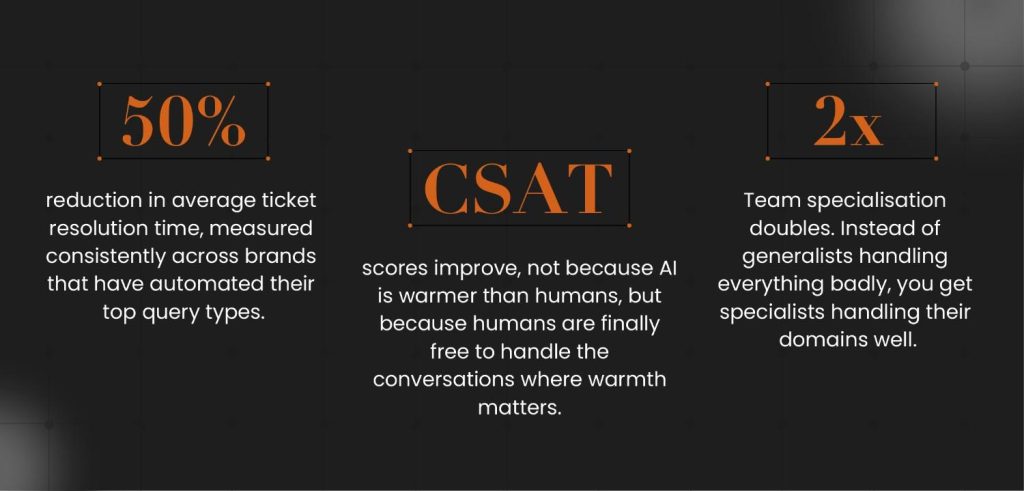
When your team isn’t buried in WISMO tickets eight hours a day, something interesting happens. They start developing real expertise. One agent becomes the go-to for subscription retention. Another gets very good at de-escalating difficult situations. Another starts contributing to product feedback loops. The team shrinks in headcount but grows in capability.
Where Your Human Agents Should Focus Their Energy
- High-stakes complaints where empathy and judgment drive retention
- Complex multi-step issues that require cross-team coordination
- VIP customer relationships and proactive outreach
- Monitoring AI agent performance and flagging edge cases for retraining
- Feeding insights back into product and operations teams
- Creating and maintaining help content to keep self-service accurate and current
The next wave of AI agent capabilities for ecommerce includes actions, not just answers. AI agents that can actually cancel an order, issue a refund, swap an item in a subscription, or update a shipping address without any human involvement. Not just informing customers, but doing things for them.
We’re also seeing the rise of AI-powered quality assurance systems. These systems evaluate every AI-handled conversation for tone, accuracy, and brand alignment, flagging issues automatically rather than relying on random human sampling. For teams serious about maintaining standards at scale, this is transformative.
And then there’s the shift from reactive to proactive. Earlier, AI agents mostly responded. But now, they are proactively reaching out, notifying customers of delays before they think to ask, offering solutions before frustration sets in, and personalizing the shopping experience in real time based on behaviour signals.
Conclusion
AI customer service automation is no longer just a cost-saving tool, it’s becoming a real competitive advantage for ecommerce brands. By automating high-volume tasks like order tracking, returns, subscriptions, and policy queries, businesses can significantly reduce response times and improve customer satisfaction.
The key is not full automation, but smart automation. Start with repetitive, rule-based queries and expand gradually based on results and customer feedback.
At the same time, the goal isn’t to remove humans from support. The strongest systems combine AI speed with human empathy, allowing agents to focus on complex issues, retention, and meaningful customer relationships.
Build Smarter CX with AI Agents
If you’re looking for an AI agent for customer service, sales and engagement, Exei help ecommerce brands automate support, improve engagement, and drive sales across channels like website, WhatsApp, Instagram, Shopify, and voice.
From handling routine queries to powering contextual sales conversations, Exei helps you scale customer experience without scaling support complexity.
Frequently Asked Questions
-
1. How much of customer service can AI agents automate for ecommerce brands?
AI agents can typically automate 40–60% of ecommerce customer service tickets, depending on product complexity and query mix. Many brands start at 30% and scale up gradually.
-
2. Will AI customer service automation affect my brand voice and tone?
No if your AI agents are properly trained. Modern AI agents can be trained on your brand’s specific tone, vocabulary, policies, and example conversations. AI agents can follow your brand tone, policies, and past conversations. Poor tone usually comes from weak setup, not AI itself, so invest in a proper setup.
-
3. Which customer service tasks should ecommerce brands automate first?
Start with your highest-volume, lowest-complexity tickets, answering repetitive queries like order tracking (WISMO), returns, subscription changes, discount questions, and policy FAQs. Automate these first, measure the results, then expand to slightly more complex scenarios.
-
4. Will AI agents replace human customer support teams?
No. AI agent handles repetitive tasks, while human agents focus on complex issues, escalations, and high-value customer interactions.
-
5. How long does it take to see results from AI customer service automation?
Most brands see early improvements within 30 days. However, full ROI, including team restructuring benefits and CSAT improvements, usually becomes clear within 90–120 days.
Lorem ipsum dolor sit amet, consectetur adipiscing elit. Ut elit tellus, luctus nec ullamcorper mattis, pulvinar dapibus leo.


