


As AI adoption accelerates across industries, White Label AI Agents have emerged as one of the most important enablers of digital transformation in 2026. They allow enterprises, SaaS companies and service providers to deploy AI-powered agents under their own brand without building complex AI infrastructure from scratch.
To understand the value and choose the best White Label AI Agents platform for your organization, it’s critical to first understand what “white label” means in the context of AI.
What Does White Label Mean in AI Agents?
In simple terms, white label refers to a ready-made product or technology that another company can rebrand, customize and integrate as if it were its own. In the context of White Label AI Agents, this means:
- The platform provides pre-built AI agent capabilities.
- Businesses can rebrand, customize workflows and deploy these agents under their identity.
- The end users view the AI agent as belonging fully to the business, not the underlying vendor.
White Label AI Agents platforms typically offer multi-agent orchestration, domain adaptation, security controls, integration libraries and dashboards all while remaining invisible to the end customer.
Did You Know?
The AI Agents market is valued at USD 7.84 billion in 2026and is expected to reach USD 52.62 billion by 2030, growing at a CAGR of 46.3%.
Why White Label AI Agents Are Essential in 2026
Organizations in 2026 face a dual challenge: expanding AI capabilities while maintaining control over brand, data and customer experience. White Label AI Agents solve this by offering:
1. Faster Go-to-Market
Building proprietary AI agents takes months. White label solutions reduce this to days or even hours.
2. Cost Efficiency
They eliminate the heavy R&D, infrastructure and AI engineering costs associated with developing agents in-house.
3. Enterprise-Grade Governance
Platforms now include audit trails, fine-grained role controls and model transparency features needed for enterprise AI governance.
4. Ability to Scale Across Use Cases
In 2026, the most successful companies are using White Label AI Agents for customer service, sales, HR automation, IT ops, cybersecurity, compliance and internal productivity.
5. Competitive Differentiation
SaaS companies and consulting firms use white label agents to enhance their product offerings without revealing the underlying provider.
As AI becomes a core differentiator, the ability to deploy brand-aligned intelligent agents rapidly and securely is now a strategic necessity.
Top White Label AI Agent Platforms in 2026
In 2026, White Label AI Agents platforms vary widely in maturity, focus and deployment models. The options below illustrate different approaches to building branded, enterprise-ready AI agents, each with distinct strengths and trade-offs that business and product leaders should evaluate carefully.
1. Exei
Exei is an agentic AI platform focused on customer service automation and operational task offloading, enabling businesses to create AI agents that work across web, messaging, and social channels while keeping interactions branded under the business itself.
- No-code, self-service interface designed for non-technical teams.
- Multi-channel deployment: websites, WhatsApp, Instagram, Facebook, Slack, Shopify, and more, plus custom integration via documented APIs.
- Supports 80+ languages and accepts text and audio inputs, widening customer reach.
- Flexible training from website content, documents, APIs, and direct text input for rapid domain adaptation.
- Built-in analytics and insights from conversations, leads, appointments, tickets and sentiments to inform decisions and campaigns.
- Packaged for startups, SMBs and larger enterprises with tiered pricing and a self-serve entry point.
2. Amazon Bedrock Agents
AWS Bedrock Agents provide a framework for building enterprise AI agents using multiple foundation models, integrated deeply with AWS’s data, security, and orchestration services.
- Multi-model flexibility within the AWS ecosystem.
- Strong orchestration for complex workflows.
- Enterprise-grade identity, governance and compliance.
- Native integration with AWS tools, APIs and operational monitoring.
3. Google Vertex AI Agent Builder
Vertex AI Agent Builder supports the creation of data-grounded agents that leverage Google’s strengths in search, retrieval and information management across enterprise knowledge.
- Strong grounding and retrieval for knowledge-heavy use cases.
- Integrates deeply with Google Workspace and enterprise data tools.
- Built-in capabilities for observability, versioning, and lifecycle management.
- Good for organisations with extensive unstructured or content-rich datasets.
4. Microsoft Agent Framework
Microsoft provides an open-source agent framework along with Azure AI services to create and orchestrate agents across internal business workflows and customer-facing applications.
- Seamless integration with Azure, Microsoft 365, and enterprise identity systems.
- Strong governance, access control, and compliance tooling.
- Supports multi-agent collaboration with developer-friendly components.
- Suitable for enterprise environments that already use Microsoft infrastructure.
5. OpenAI GPT-Based Agent Platforms
OpenAI’s agentic tools are built on advanced reasoning models (GPT-series) and offer APIs for agents capable of tool use, workflow execution, and natural language understanding.
- Advanced reasoning and multi-step problem solving.
- Mature developer ecosystem with extensive third-party integrations.
- Strong tool-use capabilities enabling complex automation.
- Rapid evolution of agentic capabilities and workflow support.
6. Independent Agent Platforms (e.g., Kore.ai, Cognigy, Replo AI)
Independent platforms focus on configurable, white-label AI agents tailored for CX automation, industry-specific processes and enterprise workflow integration.
- Strong visual builders and UI-level white label customisation.
- Often provide industry-focused templates (e.g., banking, insurance, retail).
- Flexible deployment options: cloud, hybrid, or on-prem.
- Good fit for organisations needing branded customer-facing automation.
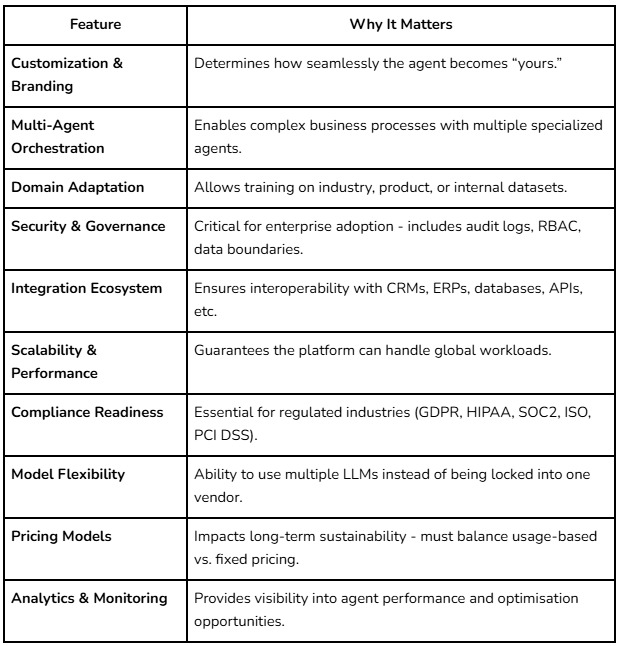
Key Features to Look for in the Best White Label AI Agents Platform
Below is a table summarizing the most critical evaluation factors in 2026:
Future Trends Shaping White Label AI Agents
The landscape is rapidly evolving and several key trends define the future:
1. Autonomous Agent Networks
Agents will collaborate, delegate tasks, and coordinate outcomes with minimal human oversight.
2. Industry-Specific Agent Templates
Banking, insurance, retail, healthcare, and manufacturing will adopt pre-built domain agents.
3. Enterprise Knowledge Mesh for Agents
Agents will natively tap into unified enterprise knowledge layers rather than siloed data systems.
4. Multi-Modal Agents
Voice, video, image, and text-based agent capabilities will become standard.
5. AI Agents as Revenue Enablers
SaaS products will embed AI agents as a core differentiator, not just an add-on.
6. Regulatory Alignment
Global AI regulations will push platforms toward transparent, auditable agent behavior.
Conclusion
In 2026, White Label AI Agents have become a strategic imperative for enterprises and SaaS businesses seeking differentiation, efficiency, and scalable intelligence. While several platforms lead the market, the “best” platform ultimately depends on your business goals, technical ecosystem, and governance requirements.
Organizations that adopt the right White Label AI Agents platform today will be better positioned to innovate, accelerate customer value and build future-proof digital capabilities.
Ready to build your own branded AI Agent platform?
Exei empowers businesses to create, customize, and scale white label AI agents that reflect their brand identity and deliver measurable value.
Frequently Asked Questions
-
1. What are White Label AI Agents?
White Label AI Agents are pre-built AI systems that companies can customise, brand and deploy as their own to automate tasks, workflows and customer interactions.
-
2. Why are White Label AI Agents important in 2026?
They help businesses launch AI capabilities faster, reduce development costs and deliver consistent, branded customer experiences across channels.
-
3. Who benefits the most from White Label AI Agents?
Enterprises, SaaS companies, digital transformation teams and startups that need scalable automation without building AI infrastructure from scratch.
-
4. How do I choose the best White Label AI Agent platform?
Evaluate customisation options, branding flexibility, security, integrations, scalability, compliance readiness, analytics, and pricing.
-
5. Are White Label AI Agents safe for enterprise use?
Yes, when the platform includes enterprise-grade governance, data controls, auditability, and compliance with standards like GDPR and SOC2.


