


Enterprises today face constant pressure to move faster, make better decisions, and accomplish more with fewer resources. Traditional AI helped automate specific tasks and analyze historical data, but in many organizations, that is no longer enough. Leaders are now looking for AI systems that don’t just assist humans but actively take initiative, make decisions, and drive outcomes.
That shift is where Agentic AI comes in.
This blog offers a clear, business-first view of Agentic AI Explained (what it means, why enterprises are adopting it and how it delivers measurable business value) without diving into technical complexity.
Why Enterprises Are Moving Beyond Traditional AI
Most enterprises already use AI in some form (dashboards, chatbots, recommendation engines, or predictive reports). While useful, these systems still depend heavily on human intervention. Someone must interpret insights, decide next steps and trigger actions.
In fast-moving environments, that delay costs time, revenue and opportunity.
Enterprises now need AI that can:
- Act in real time
- Coordinate across systems
- Continuously learn from outcomes
- Reduce operational bottlenecks
This need is driving interest in Agentic AI.
Did You Know?
The Agentic AI market is accelerating rapidly, projected to grow from USD 7.06 billion in 2025 to USD 93.20 billion by 2032, driven by a remarkable 44.6% CAGR, signaling strong enterprise confidence in autonomous AI systems.
What is Agentic AI?
Agentic AI refers to AI systems designed to operate as autonomous agents. Instead of waiting for instructions, these systems can:
- Understand a business goal
- Decide what actions are needed
- Execute those actions across tools and workflows
- Monitor results and adjust behavior
Think of Agentic AI as a digital business operator, not just a digital assistant.
For example, instead of showing a sales manager a report about declining conversions, an Agentic AI system can identify the issue, adjust pricing rules, trigger targeted campaigns and alert teams automatically.
Agentic AI vs Traditional AI: A Business Perspective
The major & simple difference between Agentic AI vs Traditional AI is that while Traditional AI is reactive, Agentic AI is proactive.
Here’s a simple comparison between Agentic AI vs Traditional AI from an enterprise lens:
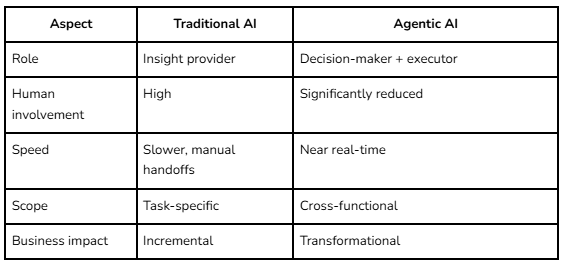
This shift from “insight” to “action” is what makes Agentic AI a strategic asset.
Read more: Agentic AI vs Traditional Automation: Why Modern Enterprises Can’t Treat Them the Same
Key Enterprise Benefits of Agentic AI
The true value of Agentic AI lies in its ability to convert intelligence into action. For enterprises, this means faster decisions, lower operational friction and scalable impact across business functions.
1. Faster Decision-Making
Agentic AI reduces decision latency by acting on insights immediately. Enterprises no longer wait for reports to be reviewed or approvals to be routed – critical actions happen in real time.
2. Higher Operational Efficiency
By autonomously handling repeatable decisions and workflows, Agentic AI frees teams from constant firefighting. This results in leaner operations and better resource utilization.
3. Reduced Human Dependency
Human expertise remains vital but not for every routine decision. Agentic AI takes ownership of operational execution, allowing people to focus on strategy, creativity, and relationships.
4. Scalable Intelligence Across Functions
Unlike siloed tools, Agentic AI operates across departments (sales, operations, finance, HR) scaling enterprise intelligence without scaling headcount.
5. Better Customer and Employee Experiences
Autonomous agents respond faster, personalize interactions, and reduce friction. Customers get quicker resolutions and employees face fewer manual processes.
For detailed benefits of Agentic AI for business growth, read https://exei.ai/ai-agents-in-business-growth-from-automation-to-decision-making/
Real-World Enterprise Use Cases
Across industries and functions, enterprises are deploying Agentic AI to eliminate delays, reduce manual intervention and drive continuous operational improvement at scale.
1. Sales & Revenue Operations
Agentic AI agents monitor pipelines, identify stalled deals, adjust outreach strategies, and trigger follow-ups, boosting win rates without adding sales pressure.
2. Customer Support
Instead of routing tickets, Agentic AI resolves issues end-to-end, escalates only when necessary and continuously improves service quality.
3. Finance & Risk Management
Autonomous agents detect anomalies, manage reconciliations and ensure compliance which reduces errors while accelerating financial close cycles.
4. Supply Chain & Operations
Agentic AI predicts demand changes, adjusts inventory levels and reroutes logistics proactively, keeping operations resilient.
5. HR & Workforce Operations
From onboarding workflows to policy queries and attrition prediction, Agentic AI improves employee experience while lowering administrative load.
Challenges and Considerations Enterprises Should Know
While the benefits are compelling, adoption requires thoughtful planning.
- Trust & Accountability: Leaders must define where autonomy begins and ends. Clear governance ensures AI decisions align with business ethics and regulations.
- Change Management: Teams need confidence in working alongside autonomous systems. Adoption succeeds when AI is positioned as an enabler, not a replacement.
- Governance & Oversight: Enterprises must establish monitoring, auditability and override mechanisms to maintain control while enabling autonomy.
Agentic AI works best when aligned with strong leadership intent and organizational readiness.
Enabling Responsible Agentic AI Adoption with Exei
For many enterprises, the challenge with Agentic AI is not ambition but execution. Concerns around trust, governance and change management often slow down progress even when the business case is clear.
Platforms like Exei are designed to bridge this gap by helping organizations introduce Agentic AI in a controlled, business-aligned manner. By enabling intelligent AI Agents for customer service and repetitive operational tasks, Exei allows enterprises to reduce support load, standardize responses and improve efficiency while keeping humans focused on complex, high-value work.
With omnichannel reach and support for over 80 chat and voice languages, Exei allows enterprises to scale Agentic AI experiences consistently across customer touchpoints.
Learn more about responsible Agentic AI adoption at exei.ai.
Final Thoughts
Agentic AI is an evolution in how enterprises operate. As markets become more dynamic, organizations that rely only on human-led decision loops will struggle to keep pace.
Future-ready enterprises will:
- Delegate operational intelligence to AI agents
- Use humans for strategic direction and judgment
- Build systems that learn, act, and adapt continuously
In short, Agentic AI Explained is about moving from AI that informs to AI that performs.
Frequently Asked Questions
-
1. What is Agentic AI in simple terms?
Agentic AI refers to AI systems that can autonomously decide and act to achieve business goals, rather than only providing insights or recommendations.
-
2. How is Agentic AI different from traditional AI?
Traditional AI supports decision-making, while Agentic AI takes ownership of decisions and executes actions across workflows with minimal human intervention.
-
3. What business problems does Agentic AI solve best?
It reduces decision delays, operational inefficiencies, manual workload and dependency on constant human oversight in repetitive processes.
-
4. Is Agentic AI suitable only for large enterprises?
No. While large enterprises benefit at scale, mid-sized organizations also use Agentic AI to improve efficiency and accelerate growth without adding headcount.
-
5. What should enterprises consider before adopting Agentic AI?
Clear governance, trust boundaries and change management are essential to ensure autonomous systems align with business goals and compliance needs.


