

Every small business owner is hearing the same pitch right now:
“Add an AI Sales Agent and watch your revenue grow.”
It sounds compelling. Especially when you’re juggling marketing, sales, and operations with a lean team. An AI Sales Agent promises to capture leads instantly, follow up without fail, and scale your outreach without hiring.
The shift toward AI in sales is not just hype. According to McKinsey & Company, companies using AI in sales have seen productivity improvements of 10 to 20%. Similarly, Salesforce reports that high-performing sales teams are 2.8x more likely to be using AI in their processes.
But here’s the uncomfortable truth most business leaders won’t tell you:
AI doesn’t fix bad sales. It exposes it.
If your messaging is unclear, your funnel is messy, or your leads are low quality, adding an AI agent for sales will not solve the problem. It will just make the inefficiency faster and more visible. On the other hand, if your foundation is solid, Agentic AI for sales can act as a force multiplier, turning a small team into a high-performing sales engine.
This blog goes deeper than surface-level benefits. It breaks down where a Sales AI Agent truly creates leverage for SMBs, where it quietly fails, and how to think about it like a system, not a tool.
What Is an AI Sales Agent?
At a basic level, an AI sales agent is designed to:
- Capture inbound leads
- Engage prospects across channels (website, email, chat, WhatsApp)
- Qualify them based on intent and fit
- Route them to the next step (call, demo, purchase)
Most modern implementations are powered by large language models like ChatGPT and integrated into CRMs such as HubSpot or Zoho CRM.
But that definition is still incomplete. A more accurate way to think about it: An AI agent for sales is a layer that sits between your demand (leads) and your conversion (revenue), optimizing the flow between the two.
That distinction matters because most SMBs don’t have a tooling problem. They have a flow problem:
- Leads come in but aren’t responded to quickly
- Prospects ask questions but don’t get clear answers
- Follow-ups are inconsistent
- Sales reps spend time on the wrong leads
An AI agent for lead capture doesn’t just automate tasks, but it restructures how attention is distributed across your funnel.
Opportunities: Where AI Sales Agents Create Real Leverage for SMBs
1. Speed as a Competitive Advantage (Not Just Convenience)
Speed and responsiveness are not just operational advantages. They directly impact revenue. Research from Harvard Business Review shows that companies responding to leads within an hour are 7x more likely to qualify them.
An AI agent for lead capture ensures that this window is never missed, turning response time into a competitive advantage rather than a bottleneck. Most SMBs fail here, not because they don’t care, but because:
- Leads come in outside business hours
- Teams are too small to respond instantly
- There’s no structured response system
An AI agent for lead capture solves this structurally:
- Instant responses 24/7
- No dependency on human availability
- Consistent first touchpoint
But the deeper insight is: AI doesn’t just improve speed, it changes buyer perception. When a prospect gets an immediate, relevant response, your business feels more professional, reliable and easier to work with. That perception alone increases conversion probability.
2. Turning Chaos Into a System
Most SMB sales processes look like this:
- Leads from website
- Leads from ads
- Leads from referrals
- Conversations scattered across email, WhatsApp, and calls
There is no unified flow, just a flow of activity. A sales AI agent introduces structure:
- Standardized qualification questions
- Consistent follow-up logic
- Clear routing rules
But prodctivity gains don’t come from automation alone. They come from forced clarity. To implement AI, you must define:
- What is a qualified lead?
- What happens after qualification?
- When should a human step in?
AI forces SMBs to answer questions they’ve been avoiding.
3. The Economics of Attention
Sales is fundamentally about attention:
- Who gets a response
- How fast do they get it
- How relevant that response is
In a small team, attention is scarce. This leads to high-value leads often being missed and low-quality leads consuming time. Besides, it results in inconsistent engagement. An AI sales agent changes the economics:
- Every lead gets attention
- High-intent leads get prioritized
- Low-intent leads are filtered early
This is where Agentic AI for sales becomes powerful. It doesn’t just respond, but it allocates attention intelligently.
4. Personalization Without Hiring More People
Personalization is no longer optional. Customers today expect brands to treat them as individuals, not as a mass audience. But SMBs often lack the money, manpower, or systems to deliver it at scale.
AI breaks this constraint. An AI agent can help personalize the shopping journey for an individual user. AI agent for shopping recommendation:
- Reference user behavior (pages visited, queries asked)
- Tailor responses dynamically
- Adjust tone and messaging
- Recommend products based on their preferences, browsing history, and past purchases
The key shift here is subtle but important: Personalization is no longer a resource problem. It’s a design problem. SMBs that take personalization into consideration not only drive sales but also customer loyalty.
Also read: Personalization at Scale: How AI Agents Transform Customer Satisfaction
5. Scaling Without Breaking the System
Growth creates pressure for more leads, conversations, and follow-ups. And without systems, growth leads to:
- Slower response times
- Lower conversion rates
- Team burnout
A Sales AI Agent allows SMBs to scale demand without breaking execution. But this only works if:
- The underlying process is sound
- The AI is aligned with business goals
Otherwise, you’re just scaling inefficiency.
Challenges: Where AI Sales Agents Quietly Fail SMBs
According to Gartner, a significant portion of AI projects fail to deliver expected ROI, not because of the technology itself but due to unclear objectives and poor implementation strategy.
For SMBs, this risk is even higher. Without a defined sales process, an AI agent for sales can quickly become just another tool, rather than a revenue driver.
1. The Illusion of Automation
Many SMBs approach AI with this mindset: “If we automate sales, we’ll grow faster.” But automation without clarity leads to:
- Generic conversations
- Poor lead qualification
- Confused prospects
The real issue is not technology; it’s thinking. AI cannot replace strategic decisions. It only executes them. So, it always requires human intervention for the strategic part of the automation.
2. Bad Data Is a Silent Killer
Most SMBs underestimate how messy their data is:
- Duplicate leads
- Incomplete informationOutdated records
When you plug this incorrect or poor dataset into a Sales AI Agent, you get:
- Irrelevant responses
- Incorrect assumptions
- Poor user experience
This is why many AI implementations “fail” quietly. They don’t crash, they just underperform.
3. Over-Automation Damages Trust
Not every interaction should be automated. In industries such as real estate, consulting, and B2B services, buyers expect human interaction at key moments. An over-reliance on an AI agent for sales can:
- Feel impersonal
- Reduce trust
- Hurt brand perception
The insight here is that automation should handle volume, while humans should handle nuance. While AI can carry out repetitive tasks, the human touch is crucial for businesses to build customer relationships. For instance, in a real estate business set up, an AI agent can book appointments, handle queries, and capture leads, but to carry out the business further, a human agent is needed to convince and gain the
4. Tool-First Thinking Instead of System-First Thinking
SMBs often stack tools such as chatbots, CRM, email automation, and analytics tools to improve operations. But without integrations, they accidentally create chaos instead of efficiency.
Using tools like HubSpot or Zoho CRM helps. But only if there is a clear system behind them. Otherwise, you get:
- Disconnected data
- Broken workflows
- Poor insights
5. Underestimating Setup and Optimization
AI agent is often marketed as “plug and play.” In reality, effective implementation requires:
- Defining conversation flows
- Training prompts
- Continuous iteration
An AI agent for lead capture is not a one-time setup, but it’s an evolving system.
Real-World Examples of AI Sales Agents Driving Revenue
1. Here’s how SMBs are actually using AI today:
Sephora didn’t just deploy chatbots for support. They used conversational AI as a frontline sales agent. What they implemented:
- AI-powered assistants on messaging platforms and website
- Guided product discovery through questions (skin type, preferences, budget)
- Personalized recommendations based on responses
Sales impact:
- Higher conversion rates due to guided selling
- Increased average engagement time
- Reduced drop-offs during product discovery
Insight:
This is a clear example of an AI sales agent replacing the in-store assistant experience online. They are not just answering questions, but actively driving purchase decisions.
2. H&M: AI Driving Product Discovery to Purchase
H&M deployed conversational AI on platforms like Kik to act as a stylist. What the AI agent does:
- Asks users about style preferences
- Suggests outfits and products
- Guides users toward purchase decisions
Business outcome:
- Improved engagement among younger audiences
- Increased likelihood of purchase through guided interaction
Deeper takeaway:
This is not automation. It’s AI acting as a demand conversion layer, which is the core role of a Sales AI Agent.
3. Vodafone: AI Handling Sales + Support Conversations
Vodafone uses its AI assistant (TOBi) to manage millions of customer interactions. What’s relevant for sales:
- Handles inquiries about plans and upgrades
- Recommends relevant products based on user needs
- Guides users toward purchasing or upgrading services
Results:
- Vodafone reported TOBi handling a large share of customer conversations
- Significant reduction in human agent workload
- Faster resolution and higher customer satisfaction
Insight:
In telecom (a high-volume, price-sensitive market), AI agents directly influence upsells and plan conversions.
4. KLM Royal Dutch Airlines: Conversational AI Increasing Booking Conversions
KLM Royal Dutch Airlines uses AI across messaging platforms like WhatsApp and Messenger. What the AI agent does:
- Answers booking-related queries
- Provides flight options and pricing
- Sends booking confirmations and updates
Sales relevance:
- Reduces friction in the booking process
- Keeps users engaged within conversational channels
- Encourages completion of bookings
Outcome:
KLM reports millions of messages handled weekly, with messaging becoming a key part of its customer journey.
Key takeaway: This is an AI agent embedded inside the buying journey, not sitting outside it
5. Lenskart: AI-Assisted Selling in an SMB-to-Enterprise Context
Lenskart uses AI across its digital channels to assist customers in selecting products. What they do:
- Recommend frames based on face shape and preferences
- Assist with product comparisons
- Guide users through purchase decisions
Impact:
- Higher online conversion rates
- Reduced dependency on in-store experience
- Better customer engagement
Why this matters for SMBs:
This shows how AI sales agents can replicate high-touch selling in a digital-first environment.
6. Indian Real Estate Firms Using AI for Lead Conversion
At the SMB level, adoption is less documented but very real, especially in India. What real estate SMBs are doing:
- Running ads on Google/Facebook
- Capturing leads via landing pages
- Using AI agents for WhatsApp to respond instantly
What the AI agent handles:
- First response (“Is this property still available?”)
- Qualification (budget, location, timeline)
- Sharing brochures and pricing
- Booking site visits
Tools often integrated:
- Zoho CRM
- WhatsApp Business API + AI layer
Observed impact (from operators and agencies):
- 2–3x fasterresponse times
- Higher site visit booking rates
- Sales teams spending time only on serious buyers
Insight:
This is one of the clearest SMB use cases of an AI agent for lead capture, directly improving revenue outcomes.
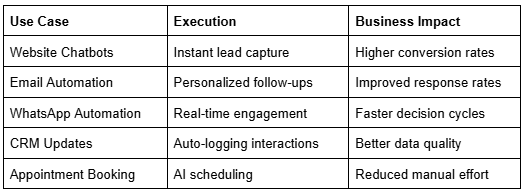
AI sales agents are not meant to replace humans. Their job is to act at the exact moment a customer shows interest, like asking a question, comparing products, or considering a purchase. They help by giving instant answers, guiding choices, and qualifying leads so potential customers don’t lose interest or drop off.
Most small and mid-sized businesses make the mistake of using AI everywhere without a clear plan. That usually doesn’t improve results. The real value comes from placing AI only where customers slow down or drop off in the sales process.
Conclusion
An AI Sales Agent is not a shortcut to better sales. It is a way to make your existing sales system more reliable. For SMBs, this matters because most revenue loss doesn’t happen at the point of selling. It happens earlier, when leads are not captured, not followed up on, or not qualified on time.
An AI agent for sales helps reduce that gap. It ensures every inbound lead gets a response, every conversation is tracked, and no opportunity is ignored just because your team is busy. But it does not fix unclear messaging, weak targeting, or a broken funnel. In fact, it exposes those problems faster.
When SMBs get the foundation right, Agentic AI for sales becomes a real advantage. It improves speed, consistency, and conversion without needing a large sales team. The result is not just automation, but a more disciplined way of selling.
If you want to explore how an AI Sales Agent can fit into your sales process and actually improve conversions, not just add automation, explore Exei. It is an Agentic AI platform that lets businesses build and deploy AI agents for customer support & engagement, boosting sales. Talk to us to drive your business growth.


