

Picture this: Your marketing team spends three weeks crafting a campaign. The messaging is sharp. The offer is solid. The list is “segmented” – enterprises with over 500 employees, the SaaS vertical, and North America. You hit send.
Open rate? 18%. Click-through? 2.3%. Replies? A handful.
You’ve seen this before. And if you’re honest, you know why it happened: you didn’t target people. You targeted a category.
Because “SaaS company with 500+ employees” doesn’t tell you what’s actually going on inside that business. One might be scaling fast. Another might be cutting costs. A third might have no urgent problem at all.
But they all got the same email. That’s the gap.
A list segment is just a filter. It tells you what someone is. But a real buyer segment tells you what’s happening right now, what they care about, what changed, and what problem is urgent.
Things like:
- what they’re actively looking for
- what just happened at their company
- what their role is struggling with today
That’s what makes a message feel relevant. Because nobody reads a generic sales email anymore, especially one that doesn’t match their situation.
This is exactly where the Agentic AI for marketing plays a crucial role.
And before you dismiss this as yet another think piece about “the future of AI,” here’s the part the hype cycle usually skips: most B2B companies aren’t using it right yet. Which, if you’re reading this, means the window of competitive advantage is still wide open.
Before you ignore this as just another “AI is the future” post, here’s the simple truth – most B2B companies still don’t know how to use it well. So you are not late, and can close this gap. Read the complete blog to understand how you can leverage Agentic AI for personalized marketing that brings business
First, Let's Be Clear: What Is Agentic AI (And What It Isn't)
The word “AI” gets used in a lot of different ways, so it can start to lose clarity. So let’s be specific about what we mean here.
Most companies today use Generative AI tools like ChatGPT or Claude that respond to prompts. You ask, it answers. You give it a prompt, and it writes a copy. It’s reactive, not proactive, like a very capable assistant who waits to be told what to do.
But Agentic AI is fundamentally different.
Think of Generative AI like a freelancer you bring in for specific tasks, while Agentic AI is closer to a senior team member who understands the goal, figures out what needs to be done, works across tools and teams, makes decisions along the way, and only checks in when needed.
In marketing terms: Generative AI drafts an email. On the other hand, Agentic AI goes further. It figures out who should receive it, when, through which channel, adjusts the message based on that account’s recent activity, and sends it. Not only this, but it also actively monitors the response, updates your CRM, and queues a follow-up. The best part? It does it all without waiting for you to hit “approve” on each step.
The technical definition: Agentic AI systems perceive data from multiple sources, reason about it, take action, and learn from outcomes. It operates in a continuous loop, without requiring constant human supervision.
The market has already noticed this. According to the report published by Precedence Research in 2025, the global agentic AI market is projected to grow from $5.25 billion in 2024 to $199.05 billion by 2034, a compound annual growth rate of 43.84%. That’s not incremental adoption. That’s a structural shift in how enterprise software works
Why Segmented Marketing Is Broken
Before we talk about the solution, let’s be honest about the problem. Traditional B2B segmentation typically looks like this:
- Firmographic segmentation: Industry, company size, geography, revenue
- Demographic segmentation: Job title, seniority level, department
- Psychographic segmentation: why” behind consumer behavior
- Behavioral segmentation: Pages visited, content downloaded, emails opened
Each of these is useful. But even combined, they tell you who a company is, not when they’re ready to buy, or what’s happening inside their organization right now that makes them a live opportunity.
A 500-person SaaS company in Chicago that downloaded your whitepaper last Tuesday could be a hot prospect, or it could be a competitor doing competitive research. Your segmentation model can’t tell the difference. However, your Agentic AI system can.
The numbers confirm the pain: outbound reply rates have dropped with Belkins indicating a decline in average B2B cold email reply rates from 6.8% in 2023 to 5.8% in 2024, even as AI tools have multiplied. More outreach, less response. The old playbook is breaking down under its own weight.
Meanwhile, 74% higher click rates are being recorded in segmented campaigns versus non-segmented ones. But “segmented” here means truly segmented, behaviorally, contextually, in real time. Not “filtered by industry.”
The gap isn’t in the data. It’s in the ability to act on it fast enough and at scale.
Enter Agentic AI: The Engine That Closes the Gap
Here’s what makes Agentic AI genuinely different for B2B marketers, and why it’s not just automation with a new label.
Traditional marketing automation runs on rules: “If someone downloads X, send email Y.”It’s predictable and scalable, but also rigid. As soon as buyer behavior doesn’t follow the expected path, the automation starts sending things that no longer make sense.
Agentic AI runs on goals, not rules. You tell the system what you’re trying to achieve, and the agent figures out how. For instance, “book 50 qualified demos this quarter from mid-market fintech companies.” The AI agent for marketing will research accounts, monitor signals, craft and adjust messaging, test channels, learn from every interaction, and adapt.
The Four Core Capabilities of Agentic AI for Marketing That Change Everything
1. Continuous Signal Monitoring
Agentic AI for marketing can track a prospect’s LinkedIn activity, company news, job postings, tech changes, intent signals, and how they interact with your content, all at the same time. For example, a company hiring multiple SDRs could signal they’re scaling sales and may need a CRM. A human SDR can’t keep up with this for more than a small list, but an agent can do it for thousands of accounts continuously.
2. Dynamic Micro-Segmentation
Instead of static lists, Agentic AI creates fluid, real-time segments. An account can move from “cold” to “high-intent” segment in hours, based on observed behavior, not quarterly CRM updates. This is the difference between fishing where the fish are, versus fishing where you thought they’d be three months ago.
3. Personalization at Depth, Not Just Surface
There’s a difference between customization and real personalization. Customization is things like “Hi [First Name], I see you work at [Company].” An AI agent for marketing goes further. It shapes the message based on context, like a Series B fintech company that just expanded into Europe and is now hiring compliance officers. That’s not a template. That’s understanding the situation and personalizing it accordingly.
4. Cross-Channel Orchestration
B2B buyers interact across email, LinkedIn, paid ads, your website, events, and review sites. Agentic AI doesn’t just operate on one channel, but it coordinates across all of them. A prospect who ignores email but engages with LinkedIn content gets rerouted. A company that keeps visiting your pricing page gets escalated to a sales rep with full context. The system is always asking: what’s the best next action for this account, right now?
Also read: Agentic AI vs Traditional Automation: Why Modern Enterprises Can’t Treat Them the Same
The 5 Practical Applications for B2B Segmented Marketing
Here’s how B2B companies are actually deploying Agentic AI across their marketing functions, not as a futuristic idea, but as a working system.
1. Autonomous Buying Committee Discovery
In B2B, you’re rarely selling to one person. You’re selling to a buying committee, typically 6 to 10 stakeholders. Most marketing campaigns target the obvious titles (VP Marketing, Head of Procurement) and ignore the rest.
The Agentic AI for marketing maps the full committee. It identifies not just the decision-maker, but the financial approver, the technical gatekeeper, the end-user champion, and the internal skeptic. Then it builds tailored content journeys for each persona, because the CFO’s objections are not the same as the IT Director’s.
This is Account-Based Marketing (ABM) done at the depth it was always intended, but rarely executed. Even those marketing leaders using an AI marketing agent may not use it to the fullest and correctly.
2. Predictive Segment Scoring and Routing
Not all leads are equal. Not all segments deserve the same investment. Agentic AI builds a predictive model using your historical win data, CRM signals, intent data, and real-time account behavior to score dynamically and route segments.
While high-intent accounts get escalated to enterprise representatives, mid-intent accounts enter a nurture sequence. Further, the dormant accounts get re-engagement content triggered by an external signal (a new hire, a funding round, a product launch).
The result? Companies using predictive models for segmentation and journey orchestration may report 20-30% higher conversion rates, not because they found more leads, but because they stopped wasting effort on the wrong ones.
3. Real-Time Content Personalization by Segment
A healthcare company and a logistics startup should not see the same case study when they land on your website. AI marketing agent serves each visitor a content experience shaped by their segment, their intent signals, and where they are in the buying journey, that too in real time, without a developer touching anything.
This is no longer theoretical. 60% of B2B marketers are already using AI for audience segmentation, and organizations seeing the ROI are the ones connecting that segmentation to dynamic content delivery, not just email lists.
Agentic AI platforms like Exei enable businesses to streamline how they capture and segment leads. By leveraging an AI agent for lead capturing, B2B marketers can interpret customer behavior and preferences in real time, delivering personalized content that boosts engagement and conversion rates.
4. Automated Campaign Sequencing and Optimization
Marketing campaigns traditionally follow a pre-planned sequence. Launch email 1 on Day 1. Follow up on Day 4. LinkedIn ad goes live on Day 7. The sequence is the same for every account.
Agentic AI breaks the calendar-based model. Instead, it triggers the next step based on behavior. A prospect who opens the email and clicks the link within 2 hours gets a different follow-up than one who opens it five days later. A LinkedIn ad gets paused for accounts that have already scheduled a demo. Budget is reallocated in real time to the channels and messages that are converting.
AI-driven teams that adopt this approach report an average 171% ROI, which is three times what traditional automation delivers.
5. Churn-Risk Segments in Customer Marketing
Agentic AI isn’t only useful for acquisition. It’s more valuable for retention.
Marketing AI agent monitors product usage, support tickets, engagement with your messages, renewal timelines, and changes within the customer’s organization. It spots at-risk accounts weeks before a cancellation happens. Then it triggers the right customer success action automatically.
This is segmentation applied to your existing book of business, not just the pipeline.
A Realistic View: Where the Challenges Actually Are
It would be dishonest to only tell the upside. Agentic AI in marketing comes with real friction that every leader should understand before investing.
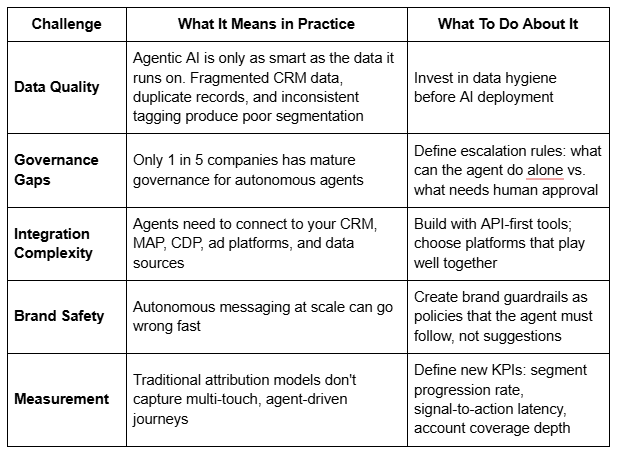
The companies getting the most out of Agentic AI are not the ones who deployed it fastest. They’re the ones who prepared their data, their governance, and their team before they turned it on.
The Competitive Reality: Where the Market Stands Today
Here’s the uncomfortable truth for anyone still “evaluating” Agentic AI: the gap is already opening.
As of 2025, 79% of organizations report some level of agentic AI adoption, with 96% planning to expand their usage. The early movers are establishing compounding advantages – better training data, tighter feedback loops, higher-quality segments that get harder to close over time.
The companies still running quarterly-refresh segmentation and rule-based automation are competing against systems that update in real time, learn from every interaction, and operate across channels simultaneously.
That’s not a productivity gap. That’s a structural one.
And yet, here’s the opportunity. Most companies are using Agentic AI badly. They’re automating old, broken processes with a new tool. Sending more emails faster to the same bad segments. Adding AI to the surface of a strategy that was never working in the first place. The real advantage goes to leaders who rethink the strategy alongside the technology.
Where to Start: A Practical Entry Point for B2B Leaders
The instinct is to start big. Don’t. Agentic AI implementations that try to solve everything at once usually solve nothing.
Instead, pick one high-value, data-rich segment and build there first.
A practical first deployment:
Start with your top 200 target accounts. Connect your CRM, your intent data platform, and your email/LinkedIn tools. Give the marketing AI agent a single goal: “Increase engagement (meetings booked) from these 200 accounts over the next 90 days.” Let it monitor signals, generate outreach, A/B test messaging, and route high-intent accounts to your representatives in real time.
This gives your team a concrete case study, your data a workout, and your leadership team a real number, not a theoretical ROI.
The Shift That Matters Most
Here’s the perspective that most AI articles miss: Agentic AI doesn’t replace segmentation strategy. It amplifies it, for better or worse.
If your segmentation logic is flawed, an agent will execute that flawed logic at massive scale, very efficiently. If it is sound, the same agent will extract value from it at a level no human team could match.
The companies that will win the next decade of B2B marketing are not the ones that deploy the most AI agents for marketing & sales. They’re the ones who combine sharp strategic thinking – who is our buyer, what do they actually need, and when? with the operational power of autonomous systems that can act on that thinking without delay, at scale, across every channel, 24/7.
That combination is rare. Right now, it’s also a significant competitive advantage. The only question worth asking: which side of that gap do you want to be on?
Conclusion
Agentic AI doesn’t change the goal of marketing, but it changes how well you execute it.
You still need to understand your buyer – what they care about and what’s changing. The difference is that you can now act on it in real time, not through static segments or delayed campaigns.
Most companies are still layering AI onto outdated playbooks. The advantage goes to those who rethink both strategy and execution.
Because this isn’t just about using AI. It’s about making marketing relevant again. And the real value of an AI agent for marketing lies in acting on insights at the right moment.
Exei helps teams operationalize this shift with real-time segmentation and execution. Exei is an Agentic AI platform that helps B2B companies automate customer engagement, run outbound campaigns, and capture leads, all without the manual overhead. It doesn’t just respond to your buyers. It works for them, continuously, across every touchpoint. Talk to an expert now.


