

In every growing business, there’s one constant challenge (keeping sales, marketing, and customer success) moving in sync. For most RevOps leaders, that alignment has always been easier said than done. Between scattered data, manual processes, and inconsistent visibility, even the best teams spend more time fixing broken links than driving real growth.
But that’s beginning to change. A new wave of intelligent automation is helping organizations connect people, data, and decisions in ways that weren’t possible before. Think of it as giving every team member a smart digital partner – one that helps you forecast more accurately, manage operations seamlessly, and act on insights the moment they appear.
Let’s unpack how RevOps and AI Agents are coming together to drive faster growth, better forecasting, and higher customer lifetime value.
Understanding the New Face of RevOps
RevOps is the connective tissue between marketing, sales, and customer success. Its purpose is to align go-to-market teams, streamline data flows, and optimize every touchpoint in the revenue lifecycle. The challenge? Data lives in silos, handoffs create friction, and decisions are often made on intuition rather than insight.
That’s where AI Agents come in. Unlike traditional automation tools that only execute predefined tasks, AI Agents can think, learn, and act autonomously. They can interpret data, make context-aware decisions, and collaborate with human teams in real time.
Imagine an AI Sales Agent that identifies patterns in lost deals, correlates them with marketing attribution data, and recommends targeted follow-ups or even executes them automatically through integrated CRM workflows. That’s not a distant future – it’s what’s already happening in advanced RevOps setups.
How AI Agents Enhance the RevOps Ecosystem
The integration of AI Agents in RevOps doesn’t just optimize existing workflows – it transforms them. Here’s how:
1. Data Unification and Enrichment
AI Agents continuously extract, clean, and merge data from CRMs, marketing platforms, and customer support tools. By using predictive analytics and machine learning, AI Agents can fill missing data fields, identify duplicate entries, and provide context like intent signals or buying propensity scores.
2. Predictive and Prescriptive Forecasting
Forecasting is one of the most complex aspects of RevOps. Traditional models rely on static data and manual reporting. AI Agents, however, can process historical performance, deal velocity, seasonal trends, and even external market data to generate highly accurate forecasts.
Beyond prediction, AI Agents can suggest prescriptive actions for instance, reallocating sales resources to high-probability accounts or adjusting campaign spend to maximize ROI.
3. Workflow Automation at Scale
AI Agents can handle repetitive operational tasks (pipeline updates, lead routing, quote generation, follow-ups) at scale and without fatigue. This frees up RevOps professionals to focus on strategic initiatives like optimizing buyer journeys or improving revenue attribution models.
4. Continuous Learning and Optimization
Unlike static systems, AI Agents improve over time. The more they interact with your sales and marketing data, the smarter they become. They identify new trends, adapt to changing buyer behavior, and fine-tune their decision-making models autonomously.
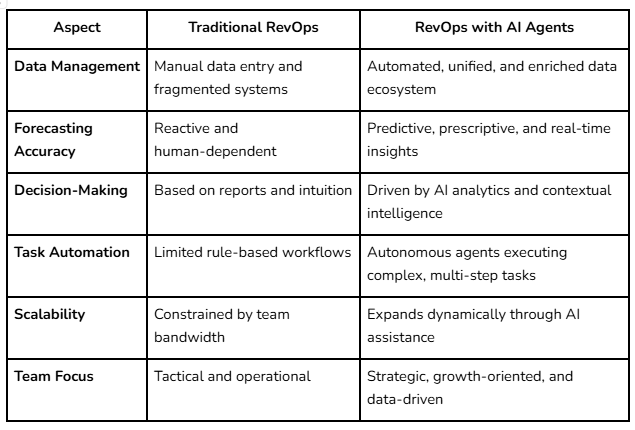
Comparing Traditional RevOps vs. AI-Enhanced RevOps
Here’s a snapshot of how AI Agents are changing the game:
Real-World Impact: From Reactive to Revenue-Intelligent
Let’s look at how leading organizations are using AI Agents to power RevOps transformation.
Example 1: Precision in Sales Forecasting
A global SaaS provider integrated AI forecasting agents into its RevOps stack. Within months, forecasting accuracy improved by 27% and the time spent generating reports dropped from 6 hours per week to under 30 minutes. The agents analyzed real-time CRM data, flagged pipeline anomalies, and auto-generated action items for each sales rep.
Example 2: Intelligent Lead Management
A B2B company deployed AI Agents that automatically scored and routed leads based on behavioral intent data. Instead of relying on static lead-scoring rules, the AI dynamically adjusted weights based on performance feedback. Conversion rates improved by 18%, and the average sales cycle shortened by 22%.
Example 3: Revenue Leakage Prevention
By monitoring end-to-end customer journeys, AI Agents detected dormant accounts, delayed renewals, and upsell opportunities before human teams did. This proactive engagement led to a 15% increase in retention and an 11% boost in upsell revenue.
What this really shows is that RevOps powered by AI Agents becomes self-correcting. It moves from being a reactive function to a proactive growth engine.
Challenges and Considerations
Adopting AI Agents in RevOps isn’t plug-and-play. There are challenges that organizations must navigate:
- Data Readiness: AI is only as good as the data it learns from. Ensuring data cleanliness and consistent tagging across platforms is non-negotiable.
- Integration Complexity: AI Agents need access to multiple systems (CRM, ERP, marketing tools). Seamless API integration is key to success.
- Change Management: Teams may initially resist AI-driven decision-making. It’s important to frame AI as an enabler, not a replacement.
- Governance and Ethics: Establish clear protocols on data privacy, transparency, and bias mitigation. Trust is critical when AI is involved in revenue decisions.
These challenges are manageable, and the long-term gains far outweigh the upfront effort.
The Strategic Payoff
For decision-makers, the value of RevOps and AI Agents goes beyond operational automation. It’s about building a system that learns continuously, executes intelligently and scales predictably.
Here’s the strategic impact executives are realizing:
- Revenue Predictability: With AI forecasting, leadership can plan with precision instead of guesswork.
- Operational Efficiency: Teams shift from manual execution to value-driven strategy.
- Customer-Centric Growth: AI insights drive personalized engagement and retention strategies.
- Competitive Advantage: Early adopters of RevOps AI are seeing faster go-to-market cycles and higher ROI on GTM investments.
When revenue operations evolve from manual orchestration to AI-assisted automation, every part of the customer lifecycle becomes more intelligent and more profitable.
What’s Next for RevOps and AI Agents
The future of RevOps will be defined by Agentic Systems – autonomous, domain-specific AI Agents working in coordination. Imagine marketing, sales, and customer success agents continuously communicating, predicting customer needs, and executing optimized actions without human intervention.
We’re already seeing signs of this future:
- Generative AI copilots that summarize pipeline health.
- Autonomous data agents that clean and synchronize records daily.
- Conversational AI agents that coach sales reps in real time during client calls.
These developments are setting the stage for RevOps 2.0 – a world where human teams focus on creativity, strategy, and relationships while AI handles the complexity beneath the surface.
Final Thoughts
RevOps and AI Agents represent a convergence of data, intelligence, and automation that’s redefining modern revenue management. For CXOs and RevOps leaders, this is a strategic imperative.
By embracing AI Agents, organizations can move from reactive firefighting to predictive precision. From fragmented insights to unified intelligence. From slow decision cycles to always-on revenue optimization.
The companies that get this right won’t just grow faster – they’ll operate smarter. And in today’s revenue orbit, that’s the real advantage.
Frequently Asked Questions
-
1. How do AI Agents improve RevOps efficiency?
A. AI Agents automate data handling, forecasting, and reporting, freeing RevOps teams to focus on strategy and growth instead of manual execution.
-
2. Can AI Agents work with existing CRM and marketing tools?
A. Yes. Most AI Agents integrate via APIs with CRMs, marketing platforms, and analytics tools to unify and act on data seamlessly.
-
3. What’s the biggest benefit of using AI Agents in RevOps?
A. They provide real-time, data-driven insights that improve revenue predictability, operational efficiency, and decision accuracy.
-
4. Are AI Agents replacing RevOps professionals?
A. No. They complement human teams by automating repetitive tasks and enabling faster, more strategic decision-making.
-
5. What challenges should companies expect during adoption?
A. Data readiness, integration complexity, and change management are key challenges but strong governance and phased deployment can mitigate them.


